
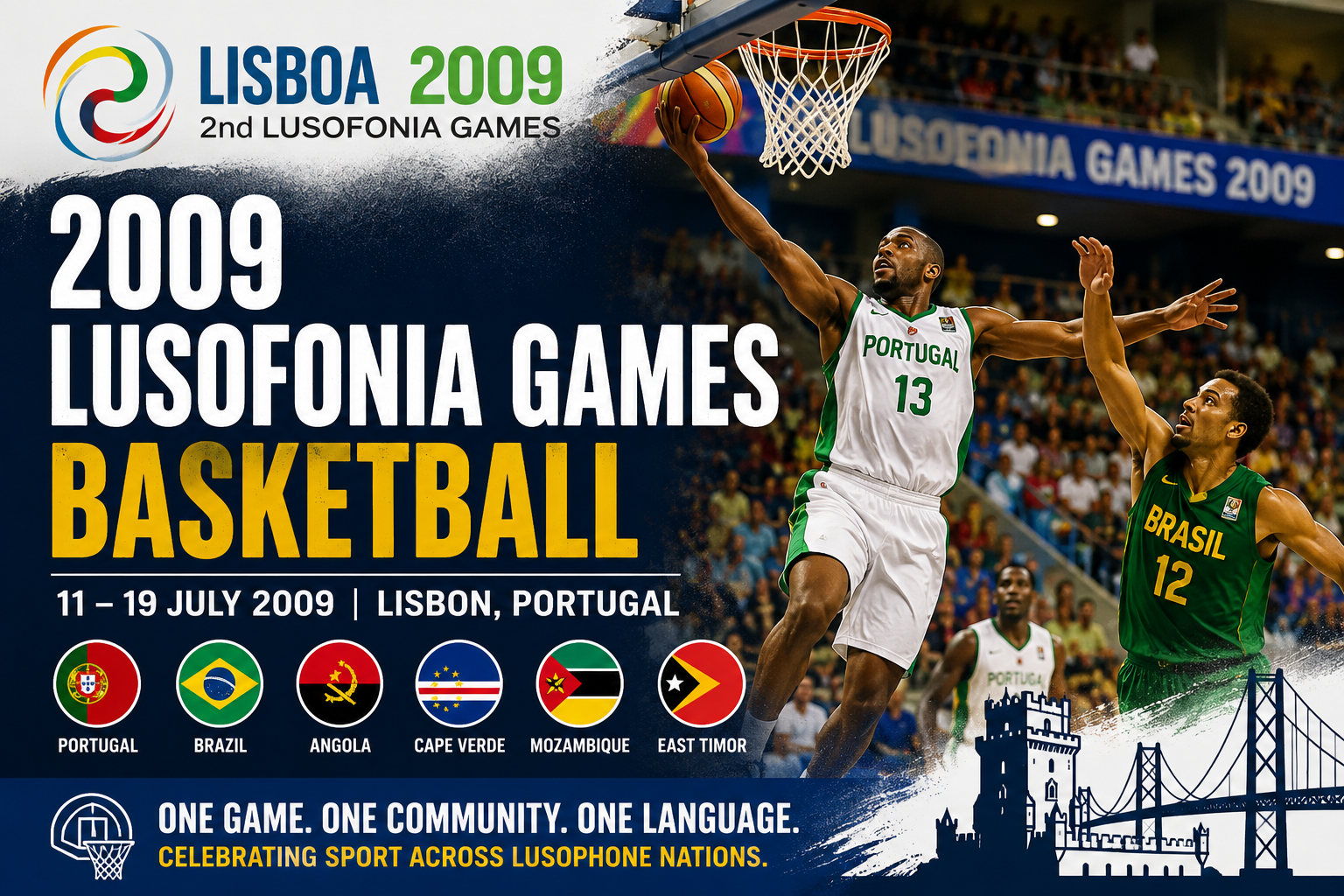
2009 Lusofonia Games Basketball, Basketball at the Lusofonia Games was one of the standout events of the second edition of the Lusofonia Games, bringing together athletes from Portuguese-speaking nations to celebrate sport, culture, and friendship. Held in Lisbon, Portugal, from 11 to 19 July 2009, the basketball competition featured both men’s and women’s tournaments, showcasing established basketball powers alongside emerging nations from across the Lusophone world. The tournament was played at the Complexo dos Desportos de Almada, one of Portugal’s premier indoor sporting venues.
What Are the Lusofonia Games?
The Lusofonia Games are an international multi-sport competition organized for countries and territories where Portuguese is spoken. The event is overseen by the Association of Portuguese-Speaking Olympic Committees (ACOLOP) and aims to strengthen cultural and sporting relationships among Lusophone nations.
Participating countries typically include:
- Portugal
- Brazil
- Angola
- Mozambique
- Cape Verde
- Guinea-Bissau
- São Tomé and Príncipe
- East Timor (Timor-Leste)
- Macau (China)
- India (Goa)
- Equatorial Guinea (later editions)
The 2009 edition represented the second Lusofonia Games after the successful inaugural event held in Macau in 2006.
Basketball Competition Overview
2009 Lusofonia Games Basketball, Basketball was among the headline sports during the Games. Separate men’s and women’s tournaments were organized with slightly different competition formats due to the number of participating teams.
Tournament Details
- Host City: Lisbon, Portugal
- Venue: Complexo dos Desportos de Almada
- Dates: 11–19 July 2009
- Events: Men’s Basketball and Women’s Basketball
- Organizer: ACOLOP in cooperation with the Portuguese Basketball Federation and FIBA.
The competition gave emerging basketball nations the opportunity to compete against stronger basketball programs such as Portugal, Angola, and Brazil.
Men’s Tournament Format
The men’s event featured multiple national teams divided into two preliminary groups.
Each team played the other teams within its group before advancing to placement games and the knockout rounds.
The format included:
- Group Stage
- Classification Matches
- Semifinals
- Bronze Medal Game
- Gold Medal Game
This structure ensured that every participating team played multiple games regardless of group-stage performance.
Strong Basketball Nations
2009 Lusofonia Games Basketball, Several countries entered the competition with rich basketball traditions.
Portugal
As host nation, Portugal entered with strong expectations.
Playing before home supporters gave the Portuguese team a significant advantage, and they displayed disciplined team basketball throughout the tournament.
Portugal eventually reached the championship game and captured the men’s gold medal after defeating Brazil.
Brazil
Brazil has traditionally been one of the world’s strongest basketball nations.
Although the Lusofonia Games did not feature the country’s full senior national squad, Brazil still fielded a highly competitive team with excellent athleticism and offensive talent.
Brazil advanced to the final before finishing with the silver medal.
Angola
Angola has dominated African basketball for decades and brought considerable experience into the tournament.
The Angolan squad demonstrated physical defense and efficient transition offense throughout the event.
They finished with the bronze medal after defeating Cape Verde in the third-place match.
Emerging Basketball Nations
2009 Lusofonia Games Basketball, One of the greatest strengths of the Lusofonia Games is providing international exposure to developing basketball programs.
Countries such as:
- Cape Verde
- Macau
- Guinea-Bissau
used the tournament as an opportunity to gain valuable competitive experience against stronger opponents.
While these nations were unable to challenge consistently for medals, the event helped accelerate basketball development across Portuguese-speaking regions.
Men’s Gold Medal Match
The championship game featured two traditional basketball nations:
Portugal vs Brazil
Portugal produced one of its finest performances of the tournament, defeating Brazil 95–71 to secure the gold medal on home soil.
The victory delighted Portuguese fans and highlighted the country’s continued progress in international basketball.
Men’s Medal Winners
| Medal | Country |
|---|---|
| Gold | Portugal |
| Silver | Brazil |
| Bronze | Angola |
Women’s Tournament
Unlike the men’s competition, the women’s basketball tournament adopted a round-robin format.
Each team played every other team once.
The standings after all matches determined the medal winners without separate knockout rounds.
This format rewarded consistency throughout the tournament.
Portugal Dominates the Women’s Event
Portugal enjoyed another successful tournament in the women’s competition.
The host nation remained undefeated throughout the round-robin stage.
Their balanced roster combined disciplined defense with efficient ball movement, allowing them to finish atop the standings and claim another gold medal.
Brazil finished second after winning three of four games, while Angola secured the bronze medal.
Women’s Medal Winners
| Medal | Country |
|---|---|
| Gold | Portugal |
| Silver | Brazil |
| Bronze | Angola |
Importance of Home Advantage
2009 Lusofonia Games Basketball, Hosting a multi-sport event often provides several competitive advantages.
Portugal benefited from:
- Familiar playing facilities
- Home crowd support
- Reduced travel fatigue
- Strong organizational preparation
These factors contributed to Portugal winning both the men’s and women’s basketball tournaments.
Home success also boosted public interest in basketball within Portugal.
Level of Competition
Although the Lusofonia Games were not a FIBA World Cup qualifier, the quality of basketball remained respectable.
Several participating countries regularly compete in:
- FIBA EuroBasket
- FIBA AfroBasket
- Olympic qualification tournaments
- Regional continental championships
The event served as an excellent platform for younger players to gain international experience before advancing to larger competitions.
Memorable Performances
The tournament featured several high-scoring contests.
Some notable results included:
- Portugal defeating Brazil in the men’s final.
- Angola claiming bronze with a convincing victory over Cape Verde.
- Portugal completing an unbeaten run in the women’s tournament.
These performances demonstrated the competitive balance among Lusophone basketball nations.
Impact on Lusophone Basketball
2009 Lusofonia Games Basketball, One of the major objectives of the Lusofonia Games is strengthening cooperation among Portuguese-speaking countries.
Basketball benefited significantly from this initiative.
The tournament:
- Increased international playing opportunities
- Encouraged youth development
- Strengthened relationships among national federations
- Promoted basketball in smaller countries
Many participating athletes later represented their countries in larger FIBA competitions.
Legacy of the 2009 Tournament
The Lisbon edition is remembered as one of the most successful Lusofonia Games.
Excellent organization, competitive matches, and strong attendance helped raise the tournament’s profile.
Portugal’s double gold medal became one of the defining stories of the Games.
For developing basketball nations, the event demonstrated that international competition was accessible even outside major FIBA championships.
The experience gained by players and coaches contributed to the continued growth of basketball throughout the Portuguese-speaking world.
Basketball and Lusophone Identity
Sport has always played an important role in connecting Portuguese-speaking nations spread across Europe, Africa, Asia, and South America.
Basketball provides an ideal platform because it is:
- Widely played
- Affordable to organize
- Popular among young athletes
- Highly competitive internationally
The Lusofonia Games strengthen not only sporting excellence but also cultural understanding among participating nations.
Conclusion
2009 Lusofonia Games Basketball, Basketball at the Lusofonia Games successfully combined competitive sport with cultural unity. Hosted in Lisbon, the tournament showcased the strength of Portuguese-speaking basketball while providing valuable experience for developing national teams. Portugal emerged as the dominant force by winning both the men’s and women’s gold medals, with Brazil and Angola also delivering strong performances throughout the competition.
Although smaller in scale than major international basketball championships, the Lusofonia Games continue to play an important role in fostering basketball across the Lusophone community. The 2009 edition remains a memorable chapter in the history of the Games, demonstrating how regional sporting events can strengthen international friendships while promoting athletic excellence.
High-authority reference: Official FIBA archive for the 2009 World Lusofonia Games basketball competition: FIBA Basketball – 2009 World Lusofonia Games

No comment